Go to the source code of this file.
| #define UNI_ID_CLEARER |
( |
|
ID | ) |
template <> struct DefaultClearer<ID> : public DefaultClearer<UNI_ID> {}; \ |
| #define UNI_ID_FORMATTER |
( |
|
UniID | ) |
|
Value:
{ \
UT::Format::Writer
w(
buffer, buffer_size); \
UT::Format::Formatter
f; \
return f.format(
w, #UniID
"({})", {
v.exintValue()}); \
} \
{ \
UT::Format::Writer
w(
buffer, buffer_size); \
UT::Format::Formatter
f; \
size_t bytesWritten =
w( \
"UT_Array<" #UniID ">([", \
sizeof(
"UT_Array<" #UniID
">([") - 1);
\
{ \
bytesWritten += f.format( \
w, first ?
"{}" :
", {}", {item.exintValue()});
\
} \
bytesWritten +=
w(
"])", 2); \
return bytesWritten; \
}
size_t UTformatBuffer(char *buffer, size_t bufsize, const ApexArray< T > &v)
GLubyte GLubyte GLubyte GLubyte w
* for(int i=0;i< n_subtasks;++i)*tasks.push(pool-> push(myfunc))
String formatting ID for debug printouts, etc:
Definition at line 126 of file UNI_ID.h.
| #define UNI_ID_SUBCLASS |
( |
|
SubClass | ) |
|
Value:class SubClass :
public UNI_ID \
{ \
public: \
constexpr explicit SubClass( NumericType id = INVALID_ID ) \
constexpr
explicit SubClass(
const UNI_ID &
id ) \
}; \
\
\
constexpr UNI_ID(NumericType id_number=INVALID_ID)
Explicit constructor.
An ID for referencing the specific UNI graph elements.
Definition at line 98 of file UNI_ID.h.
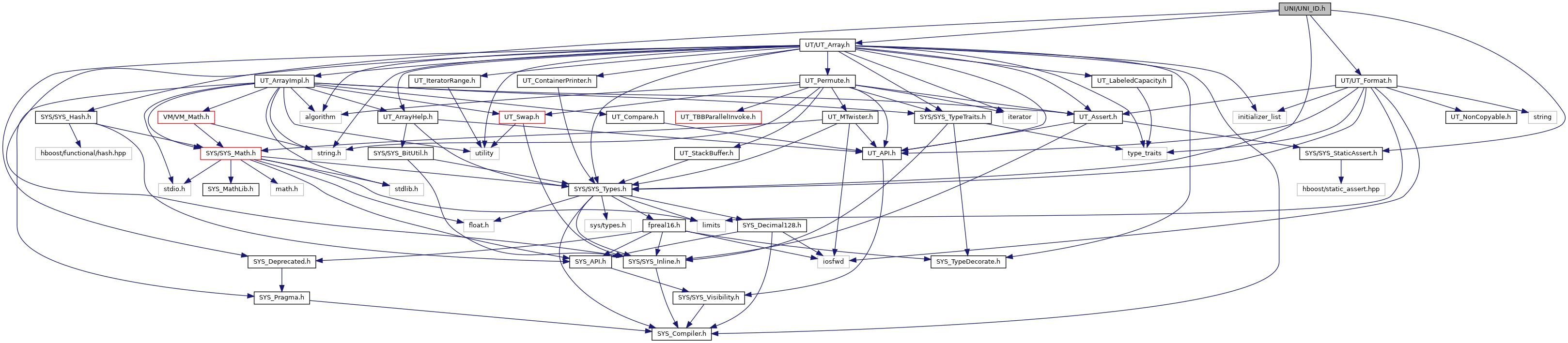
 Include dependency graph for UNI_ID.h:
 1.8.6
1.8.6