MOANA 2
WALT DISNEY ANIMATION STUDIOS
In Disney’s spectacular animated feature Moana 2, resourceful wayfinder Moana (Auli‘i Cravalho) is reunited with the boisterous demigod Maui (Dwayne Johnson) for a perilous voyage across the unpredictable seas of Oceania. Spurred on by an unexpected message from her wayfinding ancestors, Moana sets off from her home island of Motunui, and journeys into dangerous waters in search of the long-lost island of Motufetū. Only by breaking the curse can she hope to restore the connections between the people of the ocean.
The Moana 2 storyline breaks down into 46 sequences, roughly three-quarters of which involve complex water environments, ranging from a luscious tropical shoreline to raging rivers and gushing waterfalls. In addition, of course, there is the wide open ocean, whether calm or whipped to a frenzy by gales reaching level seven on the Beaufort scale. “Moana 2 is our largest and most epic effects film to date,” said Dale Mayeda, head of effects animation. “Out of 1,726 total shots in the film, 1,269 involve effects.”
Nor did the challenges stop at merely simulating the natural world. The Moana 2 storyline drew the effects team into a more magical realm. First, ocean currents drive the main characters inside a giant clam filled with enchanted rivers and waterfalls. Later, they face their final challenge – an anthropomorphic storm circling a supercell roughly two miles in diameter. “The eye of the storm is guarded by three monster tornadoes,” Mayeda commented, “each a quarter of a mile in width. It’s also surrounded by eight attack tornadoes.” The entire tempestuous ensemble is brought to the boil by carefully choreographed zaps of highly destructive lightning.

Where the Ocean Meets the Land
Many of the film’s early sequences are set on the beautiful island of Motunui, which boasts a wide range of shoreline types ranging from sandy beaches to rocky reefs. Aware of the need to preserve high-quality simulation output and maximize automation, the effects team developed a highly adaptable rigging system in order to create the necessary topologies. Artists implemented distinct geometric approaches depending on the environment type, and prepared colliders from the character and props departments for interaction. Final geometry had to be clean and watertight, in order to avoid later complications.
“The shoreline rig leveraged Houdini’s robust tools to create an efficient workflow for FLIP simulations,” said effects lead Zoran Stojanoski. “We incorporated custom attributes to provide flexibility and control.” The rig was designed to accommodate a broad spectrum of shot requirements, managing different simulation resolutions and varying area sizes.
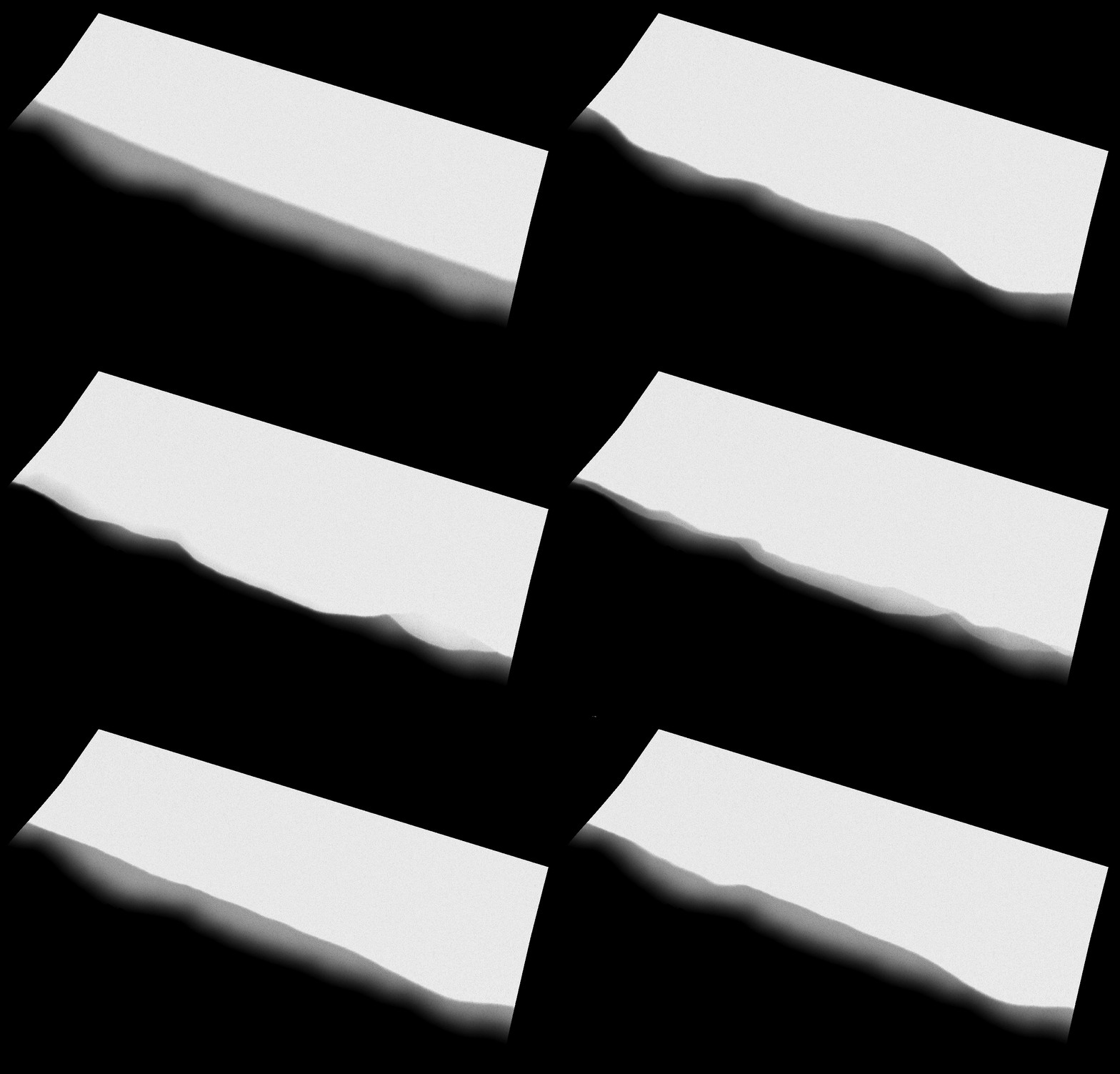
To ensure authenticity and visual fidelity, the team conducted a detailed analysis of Pacific Island shorelines. “Many reefs in the Pacific act as natural breakers,” said Stojanoski. “They dissipate wave energy before it reaches the beach, resulting in a characteristic presence of foam and turbulent water.” The research informed simulation parameters and foam generation techniques, ensuring greater accuracy and authenticity. “Our meshing process combined proprietary and native Houdini tools to create a unified water mesh, with a particular focus on the seamless integration of backwash into the beach geometry. Houdini’s procedural capabilities proved instrumental in generating the masks necessary for blending the mesh and wetmaps, ensuring a natural transition between water and land.”
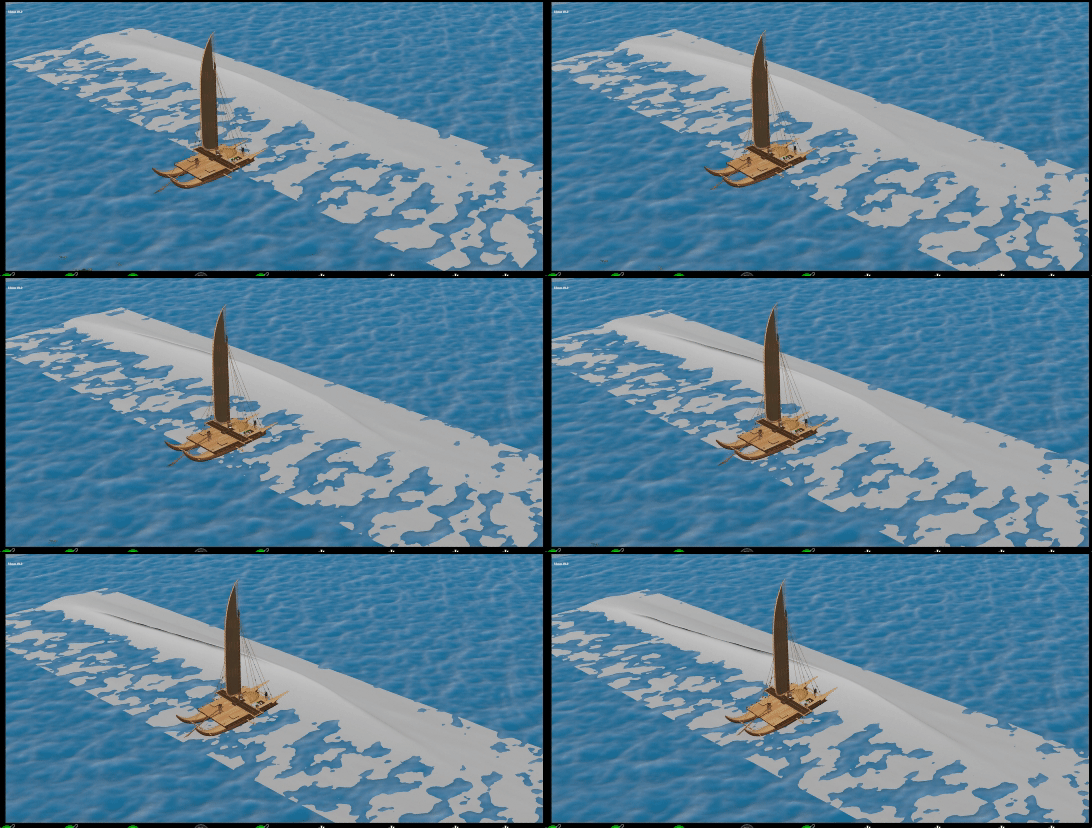
The team divided the 800-meter-long beach in front of Moana’s village into manageable sections, tailored to the scouting requirements of each sequence. “This segmentation allowed us to keep the FLIP simulation areas smaller,” said Santiago Robles, “which in turn made them lighter and more efficient.” The effects team provided layout with a variant featuring a 3D map of all available shoreline sections, enabling artists to easily visualize and select variants during their scouting process. Effects created new simulation sections on demand, as required by specific sequences.
“The new workflow significantly optimized our pipeline,” Robles commented. “It meant effects did not have to touch shots without character or boat interactions. Even when interactions were necessary, we could streamline the process by simulating only the specific action area, reusing the same spectra that had been used to generate the shoreline asset, and the timing from upstream departments.”
A Workflow Built for Water
In the early stages of production, the Disney Animation effects team faced a key decision – whether to continue using the proprietary solver developed for the original Moana, or transition to more standardized Houdini-based water workflows. Discussions were informed by a number of advances that had been made since the release of the original film in 2016.
“On the first film,” recalled Mayeda, “we developed our own proprietary water solver called Splash, plus a levelset compositing pipeline for accomplishing the numerous ocean and boat wake shots that were needed for the film.” Certain technologies developed by the team – such as Fluxed Animated Boundaries – were later incorporated into Houdini’s FLIP solver. “These developments allowed us to use Houdini’s solver directly. We were also able to employ an in-house CSG rendertime solution to blend local simulations with an extended ocean, replacing our previous levelset compositing pipeline.”
“The original solver was groundbreaking at the time,” added effects supervisor Santiago Robles, “but it had not been widely used in subsequent productions. Additionally, our team was composed largely of artists who did not work on the first film.”
The decision to adopt Houdini’s FLIP solver and ocean tools greatly improved efficiency, by aligning the workflow with industry-standard practices and reducing the training burden associated with proprietary tools. “The release of Houdini 19.5 further solidified our decision,” Robles remarked. “It introduced features such as the TMA spectrum model, shallow water solver, and enhanced FLIP SOP boundaries, domains and up-rezzing capabilities. We felt these advancements would provide flexibility and efficiency to meet the ambitious goals of the project.”
To ensure consistency between animation and rendering, the effects team baked ocean variants as vector displacement maps for use during render time. “This approach guaranteed that the high resolution ocean extending to the horizon matched perfectly with those seen in animation,” Robles observed. “It allowed us to maintain a cohesive and high-quality visual standard across the pipeline.”
“Houdini Engine came in handy for visualizing some of the very large waves in the storm sequence,” said Ian Farnsworth “We could create the Wave Deformer in layout, passed it to animation, and then pass it into Houdini where effects artists could tweak it as needed, before stitching it into the main ocean surface and adding simulations on top.”
Another Houdini feature made ocean meshing more efficient. “SideFX had back-ported the Remesh to Camera node to the Houdini version we were using,” Farnsworth commented. “For any shot that effects was going to touch with simulations, we found that baking high resolution geometry was generally faster to render – it essentially removed the need to subdivide and displace it again at rendertime.” The team pre-cached ocean geometry to optimized USD files, removing as many extra steps between SOPs and LOPs as possible once a scene was ready to render. Other ocean effects that saw improvement from the first film were foam and spray. “The Hyperion team made direct rendering of USD points, acceleration blur for meshes and points, and specular highlights on volumes a reality for us.”
Any water simulation pipeline requires the processing of a colossal amount of data, all of which must be generated and stored during every iteration. The associated read-write operations are costly, and can create significant performance bottlenecks. “To address this challenge and streamline our workflow,” said effects lead Sujil Sukumaran, “we made it a priority to minimize the amount of data written to disk, without compromising the fidelity of the final output. Houdini’s VDB toolset proved instrumental in achieving this goal.”
By leveraging frustum-based rasterization, the effects team was able to spatially constrain voxel generation to the visible regions of the camera view. This drastically reduced unnecessary data output. “We also used 16-bit precision formats,” Sukumaran explained. “This allowed us to maintain visual quality while significantly cutting down on file sizes. VDB Points further enhanced our efficiency by enabling lightweight representation of sparse particle data. Together, these workflows not only reduced disk space consumption, but also accelerated iteration times, getting out renders and simulations much faster than if we were to not optimize our data.”
Knowing the Ropes
Much of the film’s action is set on the high seas, in and around Moana’s canoe. The effects team used a variety of tools and techniques to show the interaction between the boat and the water, including a highly automated rig for creating wake effects. The wake rig needed to be extremely adaptable, working not only on Moana’s canoe but on the other vessels seen in the film, in ocean conditions ranging from flat calm to high storm.
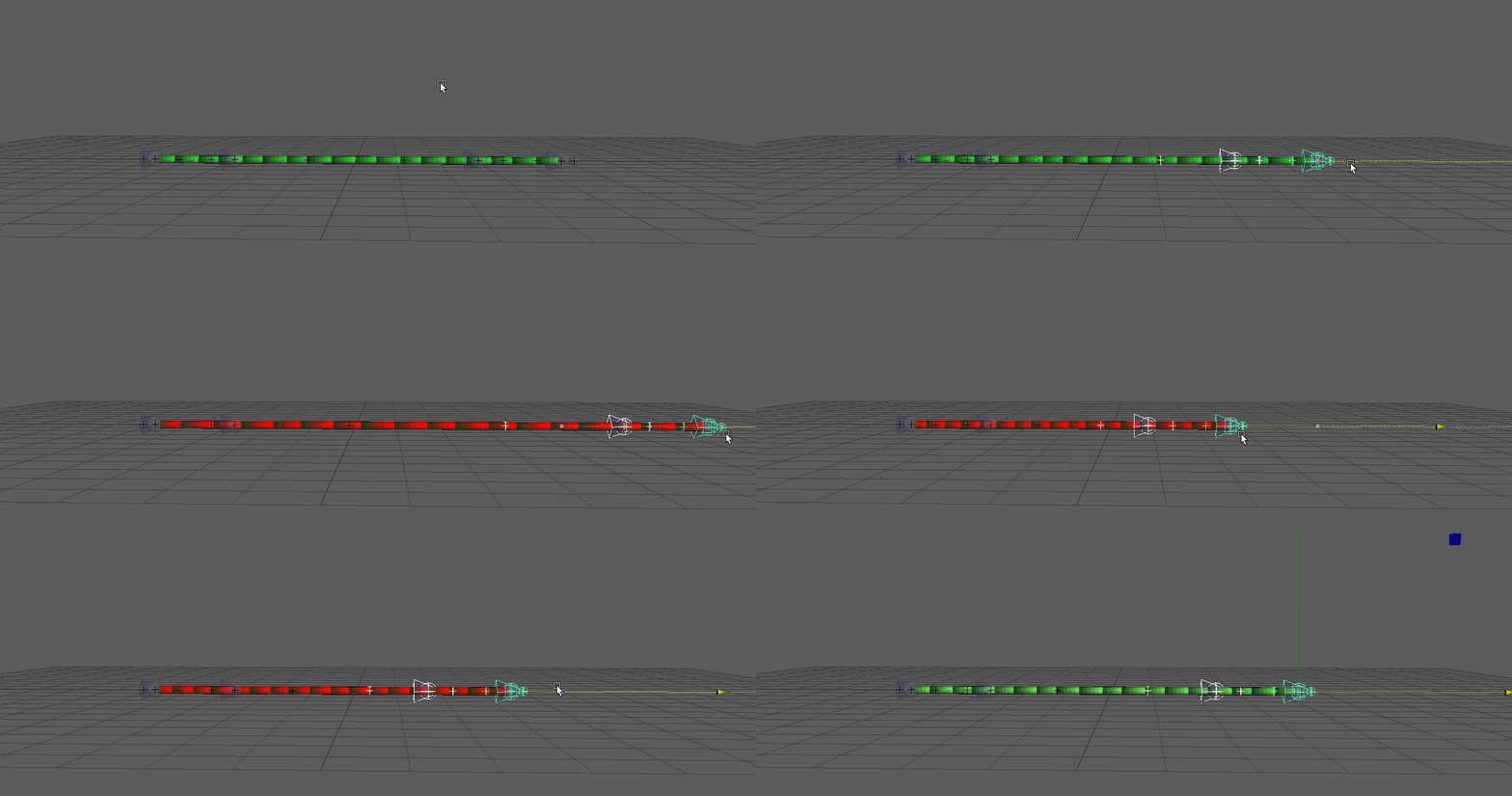
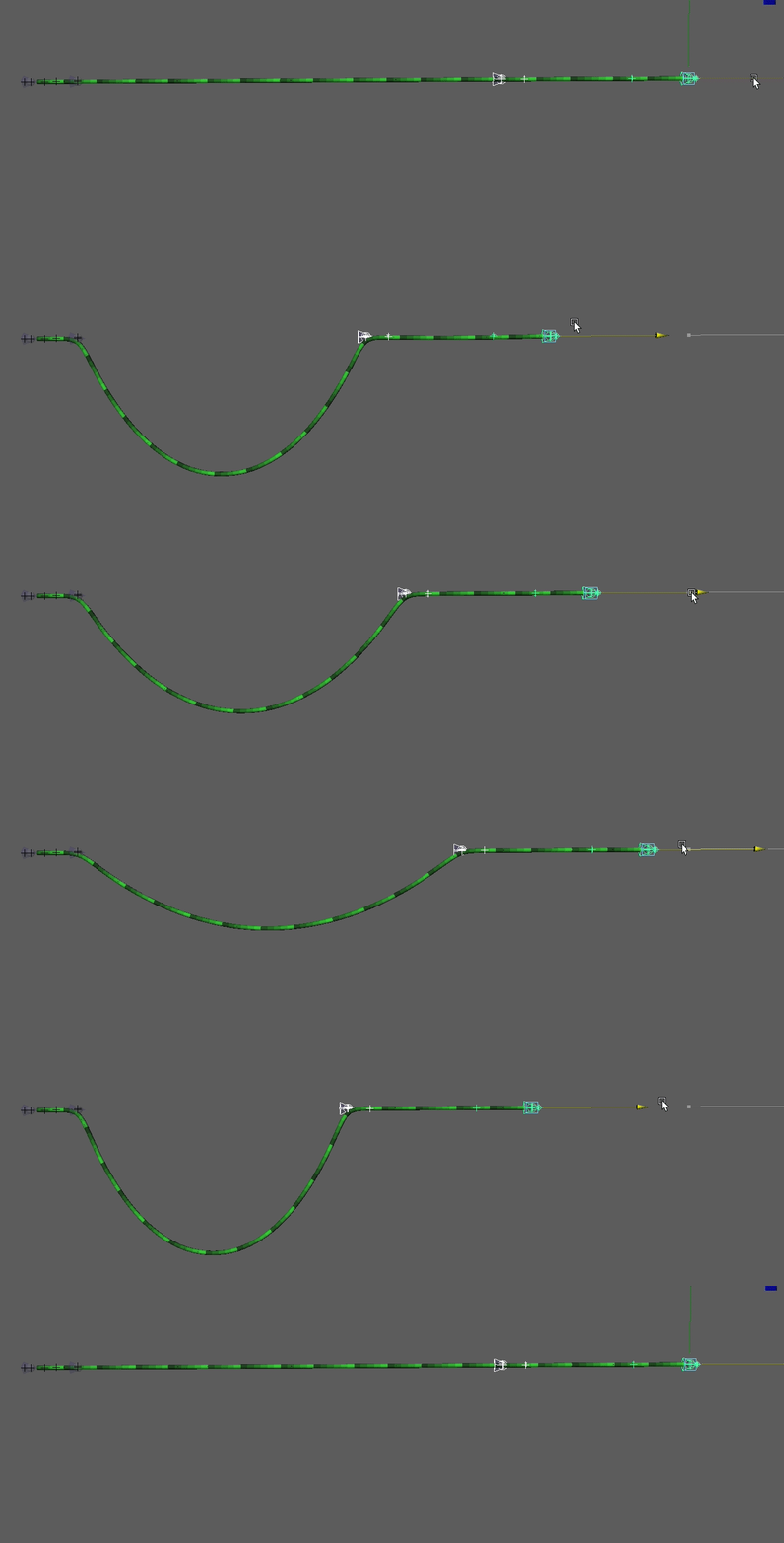
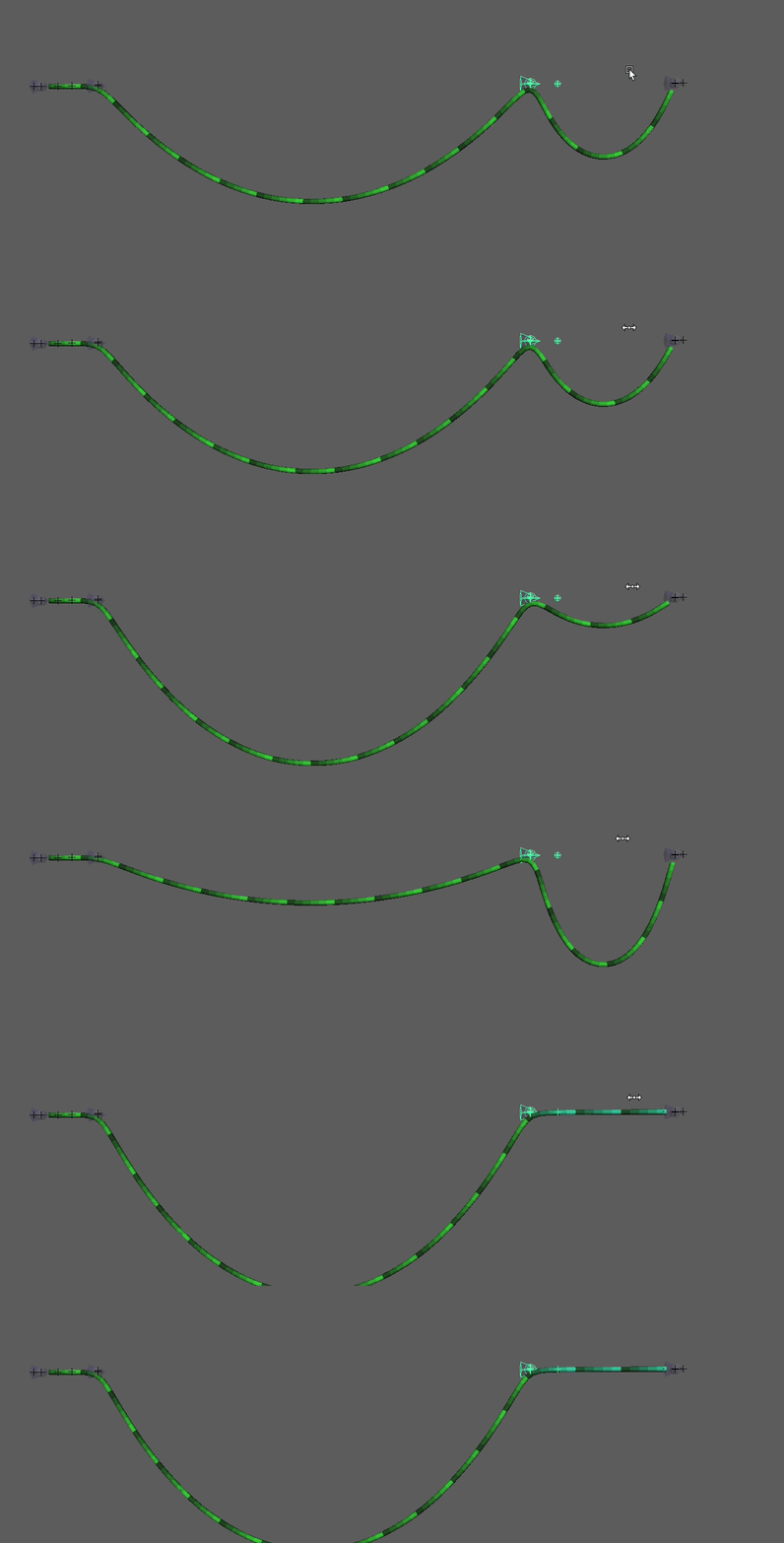
At the heart of the new rope rig was a system that took in locator positions, created a curve between them, then skinned the rope with procedural UV parameterization. “Each locator could effectively be ‘anchored’ or not,” Farnsworth explained. “This meant the animator could lock the rope to the character’s hand, or let it slide through the locator, all as needed.” In order to maintain the length of the rope and reduce stretching, the team integrated a catenary solve in VEX. “This allowed the rope to droop procedurally without the need for a simulation.” In addition, the team added visualization options enabling animators to see when ropes were getting stretched or becoming compressed.
Watery Wakes and the Canoe Splasher
Much of the film’s action is set on the high seas, in and around Moana’s canoe. The effects team used a variety of tools and techniques to show the interaction between the boat and the water, including a highly automated rig for creating wake effects. The wake rig needed to be extremely adaptable, working not only on Moana’s canoe but on the other vessels seen in the film, in ocean conditions ranging from flat calm to high storm.
During layout and animation, artists used baked geometry representations of ocean waves as reference. Ocean spectrum information traveled with each shot through the pipeline using USD data. “Once a canoe shot had gone through layout and animation,” said effects lead Deborah Carlson, “the effects department had enough information to automatically run an initial version of the boat wake effects.” Following this, the rig generated flipbook images and full renders, allowing the team to see the results immediately. “This meant we could issue a shot with informed direction on what was working and what needed manual intervention, before the artist even started on the shot. Houdini’s FLIP Configure Ocean Layer tool in SOPs provided an ideal basis for setting up the base simulations for our canoe wakes in a clean, artist-friendly way.”
Alongside the wakes that are left in the ocean surface, the boats also generate countless splashes in the water. A base bulk FLIP simulation captured overall flow and motion at coarse resolution, complemented by a fine-scale system dedicated to detailed splashes generated at the bow and stern. Separating the splasher from the bulk pass allowed each system to run at its optimal resolution.
“We called our emission setup the ‘canoe splasher,’” said Sham Kalamba Arachchi. “The splasher simulation drew on the velocities of the underlying base sim to source splashes where the canoe displaced the water. For shot-specific needs, we used art-directed controls to shape both the intensity and direction of the splashes, ensuring they matched creative intent. Artists could preview these emission trajectories with the Ballistic Path SOP, and we added a switchable mode that used lightweight POP particles in place of FLIP.” This approach gave near-real-time feedback for blocking in coverage and direction, before committing to a heavier FLIP solve.
Extending the splasher’s capabilities further, artists layered in secondary elements to bridge the transition from large coherent water masses into fine spray governed by air dynamics. “We used POP Fluids to provide spray meshes,” commented Arachchi. “These were intermediate, surface-tensioned forms that held together as smaller water clumps.” In parallel, the team simulated spray points as ballistic particles. “This way we got greater responsiveness to wind and air dynamics, and enhanced the sense of atomization into mist.”
As soon as these spray and mist elements returned to the water’s surface, they were converted into foam and advected by the base simulation’s velocity field. All the layers taken together — bulk motion, splasher details, transitional spray meshes, ballistic mist, and foam recapture — created a coherent canoe water interaction system, with a natural progression from large-scale dynamics down to finely detailed close-ups.
The Giant Clam
En route to their final destination, Moana and her crew encounter a giant Clam so big that it looks at first glance like an island. The illusion is shattered when the Clam begins to draw in the surrounding water, sucking their canoe toward its open shell.
One of the biggest challenges facing the effects team was to create a believable ocean current flowing into the Clam – one that behaved like a river but did not visually resemble one. “Our approach had to be flexible enough to work across a wide range of scales,” observed Stojanoski. “We had vast ocean areas of around 250 square meters, down to localized regions as small as two square meters.” To deliver the required flexibility, the team developed a rig that used a low-resolution simulation to identify an area of interest, including its size, position, and influence. “The part of the rig responsible for controlling the current relied on guide curves, which could either be hand-drawn by artists for fine artistic control, or generated procedurally based on the environment's topology. This allowed current forces to naturally adhere to the surrounding geometry.” Artists had the flexibility to choose either approach, or a combination of both, in order to achieve the desired result.


Having achieved a satisfactory low-resolution simulation, artists leveraged Houdini’s FLIP up-rez workflow to simulate the final water interaction. This stage used high-resolution colliders and significantly increased detail to capture the nuanced behavior of the water. “At this point, we also introduced any shot-specific custom forces to drive the final result according to creative notes, ensuring the simulation matched the artistic vision,” stated Stojanoski. “We developed a custom workflow that leveraged our proprietary meshing tools to maximize resolution in high-detail areas.”
While the approach was fundamentally different from the effects team’s shoreline workflow, where the focus was on seamlessly integrating backwash into beach geometry, it was however built on the same core toolset. “In the Clam sequence,” Stojanoski noted, “the challenge was to dynamically adapt resolution based on simulation parameters such as vorticity, speed, and depth. This allowed us to identify regions that required high-resolution treatment, while keeping the rest of the ocean lightweight and efficient for meshing.” Using these same parameters, artists also determined points of interest for whitewater and foam generation, and identified water regions near colliders that could later be used to generate wetmaps. “This unified setup allowed for a cohesive pipeline that balanced technical precision with artistic flexibility, regardless of whether the water interaction was happening near a shoreline or in the open ocean.”
The whitewater presented its own unique challenges, since the size of the simulation area could vary significantly from shot to shot. The top priority across these varying scales was achieving visual consistency. “Houdini’s procedural approach was instrumental,” said Stojanoski. “The ability to make the system adapt seamlessly by adjusting only a few parameters proved irreplaceable, allowing us to maintain both efficiency and artistic control across the entire sequence.”
To integrate the simulation mesh seamlessly into the broader ocean environment, the team relied on its open ocean setup, driven by Beaufort level spectra, to simulate realistic wave behavior across varying sea states. “Traditional ocean stitching techniques often introduced visible artifacts or mismatches,” Stojanoski commented. “Rather than use these, we transitioned to a render-time CSG approach. This allowed us to merge the simulation mesh with the surrounding ocean surface cleanly and procedurally, ensuring continuity in wave motion and shading.” The result was a unified water surface that preserved the high-detail simulation while blending naturally into the open ocean, regardless of the scale or complexity of the shot.
Instead of dealing with the subdivision at rendertime, the effects team often found it faster to feed the renderer a final quality mesh. “With the Remesh to Camera node, we developed a simple workflow that allowed us to generate the final quality mesh faster,” related Stojanoski “We paired that with a lightweight proxy geometry setup in Solaris, which allowed us to visualize our ocean meshes in near-realtime in the viewport, with the high resolution mesh going to the final renders.
Reuseability was a key component of the effects workflow. “Many shots featuring background Clam water didn’t require complex interactions,” said Robles. “We were able to efficiently reuse large-scale simulation caches to populate those areas. This significantly reduced the need for additional simulation work, streamlined production, and helped maintain visual consistency throughout the sequence.”
Eventually, Moana finds herself inside the giant Clam, surrounded by the vast network of underground rivers that flow through its depths. In order to create these rivers, the effects team developed a modular library of pre-simmed river patches. Each patch had different intensities, ranging from calm water to active rapids. “The environment was populated with a mixture of these patches,” explained Arachchi, “eliminating the need for one large simulation. Utilizing CSG at render time, we bypassed the need to stitch patches together and avoided seams entirely. We also had the ability to deform these patches around obstacles and animate them to character performance and music beats.” In cases where rivers transitioned from one type of flow to another, artists layered in connective whitewater simulations.
Just as in the ocean, it was vital that the canoe interacted realistically with the river water. “We layered in a hi-res FLIP sim for the bow and stern wakes,” Arachchi said. “This transitioned into whitewater upon landing on the base river patch. In some hero shots, we further refined the look of the river patches by running spatially clustered, high-resolution whitewater sims. These gave us the extra detail needed for close-ups.”
The Pearl and the Portal
At a pivotal moment during her quest to find Motufetū, Moana succeeds in opening a magical portal. According to the mysterious demigoddess Matangi (Awhimai Fraser), this magical gateway will “shorten the commute for you and your crew.”
The Portal is protected by a gigantic shimmering sphere, referred to as the Pearl. After many design iterations, the team settled on a final design based on an intricate mix of volumetrics, particulates and ribbons, all swirling and glowing gently inside the Pearl’s spherical boundary. “We used Houdini to generate the various volumetric and geometric elements,” said effects supervisor Marc Bryant. “We created a retimeable asset that could be easily distributed across shots that didn’t require interaction.”
Following its discovery, the Pearl fulfills several different roles in the story. At one point, Moana is imprisoned inside it. The Pearl then expands to form a vortex, before whisking the crew to a different location. “We wanted all the effects to feel connected visually,” said Bryant, “by echoing shapes and colors throughout the transitions. We used Houdini for all these moments, usually leaning on pyro simulations as a base for the motion of everything. For scenes where the characters are on the boat inside the portal, we took a more procedural approach, using instanced particles and volumes, while still maintaining a visual link to the Pearl through shapes and colors.”
Storm Clouds
To help develop the overall look of the storm clouds, the effects team studied supercell and tornado formation. “We used Houdini’s sparse pyro solver,” said effects lead Jesse Erickson, “along with custom force and buoyancy tweaks to approximate the tropopause atmospheric boundary. To create the iconic cumulonimbus anvil shape, we used a counter-rotating central updraft, and added some horizontal layering, in order to distinguish the formation as being magical.
The stakes rise as Moana and her crew enter the storm. “We needed a scalable high-detail approach that was memory efficient and could be propagated to multiple shots,” Erickson remarked. “For this, we simulated a square patch for the underside of the storm, and used Volume Deform to twist it so it could be copied into concentric rings.” To reduce visual twinning, the simulation was two-sided, allowing each instance to be flipped randomly and time-offset. “Our approach allowed targeted addressing of notes in specific areas without having to re-cache large volumes. It also gave us the ability to twist each ring to add spiral motion to shots that needed it.”
For scenes at the eye of Nalo’s monstrous storm, the team created a long tunnel of fast-moving volume leading up through the center of the storm. This was prototyped using Houdini’s minimal pyro solver – which gave quick feedback at lower resolutions – then switched over to sparse pyro for final resolution output.
Spinning Tornados
Nalo’s sentient storm is patrolled by legions of deadly tornados. In brash defiance of nature, they do not suck seawater into the air, but instead spiral downwards towards the ocean surface. This radical twist on reality presses home the story point that Nalo is using the tornados to attack Moana and her crew.
Once tornado behavior had been finalized, the layout team delivered approved ‘storm tentacles’ to effects. Artists keyed off these in Houdini in order to convert the tentacles into renderable tornados, taking advantage of Houdini’s new volume deformer workflows.
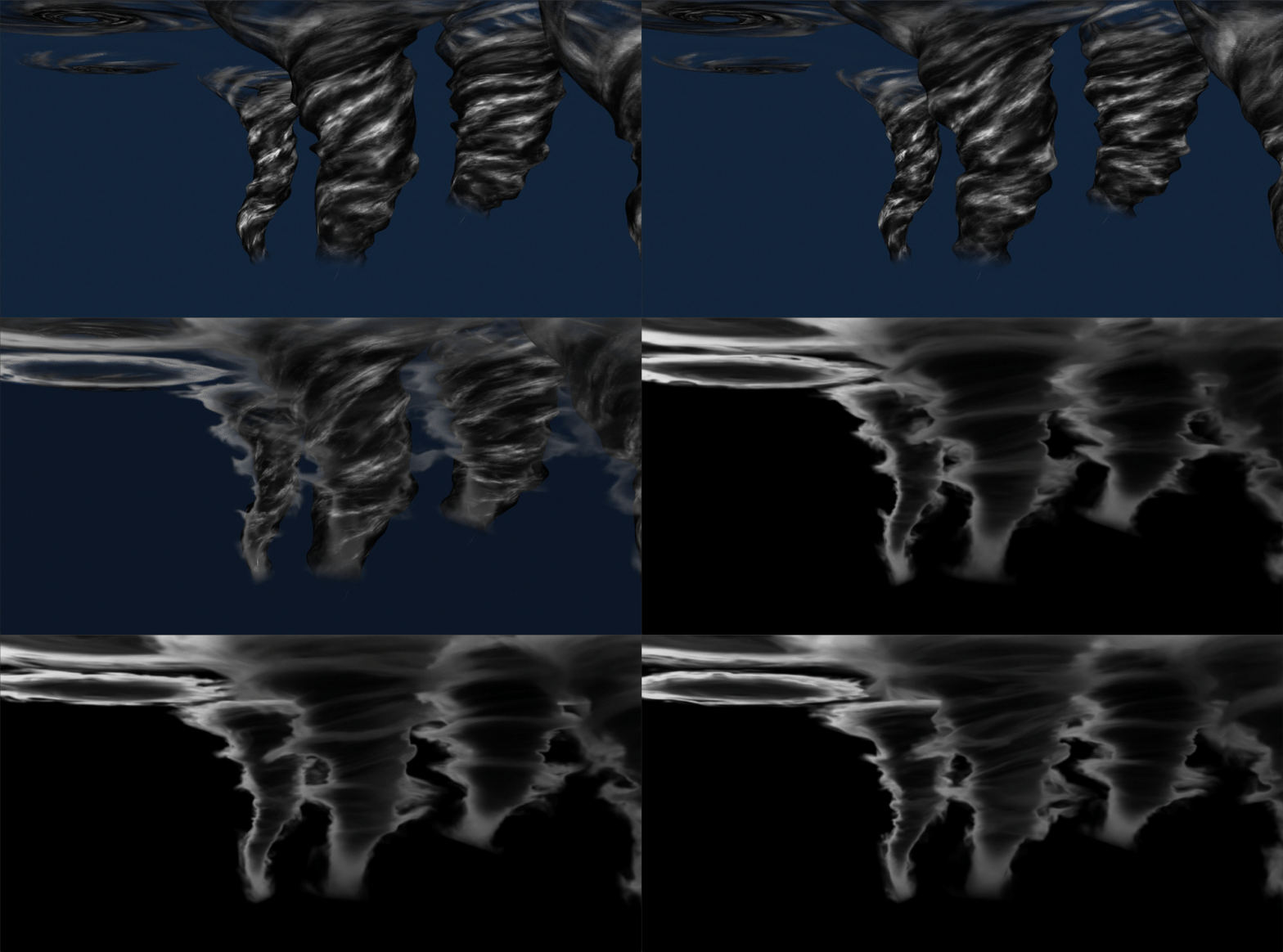
“Most of our tornados were actually not simulated in 3D space,” revealed effects lead Jake Rice. “Instead, we used a single pre-baked tornado sim that we deformed into place.” This simulation was essentially a cylinder, to which artists applied scalings and curve deformations via the volume deformer workflow. “The input guiding the deformation was the animated curve from the animation team.” If a shot required it, the team added extra simulations to augment the final look, although in most cases the quality of the pre-baked tornado proved to be high enough to hold up.
In order to sell the ‘downward spiral’ concept, it was critical that the effects team integrated the tornados seamlessly into their environment. “We devised a solution to generate unique kick-up and spray elements at the intersection point between the tornado and the water surface,” said Rice. “We dubbed it the ‘tornado skirt.’” Effects artists generated skirts for each individual tornado on a per-shot basis. “We used a combination of pyro sims and POP sims to achieve a misty look. To add an extra level of force and detail, all our tornado kick-up sims utilized an air field based off the combined forces of all the tornados. This added global turbulence and continuity between nearby tornados.”
In multiple shots, tornados are ripped apart. “Luckily for us, the volume deformer deforms velocity fields,” Rice commented. “So, during a shot, we could take over a deformed pre-baked sim and transition it into a fully simulated tornado, while retaining its velocity field. The artist could destroy this or erode it away when Maui struck its lightning core.”
Lightning Strikes
Within the storm, powerful bolts of lightning function primarily as a support element, tying together all the volumetric components and serving as the primary source of light. Since the storm is a physical manifestation of Nalo’s power, the team infused lightning strikes with the storm god’s unique design motif – a series of shark-like chevrons. These motifs serve to emphasize that this storm is a long way from being a natural phenomenon.
“The lightning strikes are mostly populated within the volumetric elements,” said effects animator Christopher Hendryx. “We did this in order to highlight their detail with dramatic backlighting. It also helps the audience to visually track whether a tornado is still a threat, as Maui eliminates each individual tornados by severing the electrical arc at its core.”
While the storm rages overhead, Maui uses his hook to raise the island of Motufetū up from the ocean floor. At this point, the lightning overtakes the tornadoes as the primary threat to the crew of Moana’s canoe, and Nalo’s motif begins to dominate the art direction.
“We authored the lightning itself using one of two methods,” Hendryx commented. “The primary setup used simple curves to which artists added attributes, either via a supplied HDA, or with wrangles in more heavily customized scenarios; these were later processed by a final HDA using those attributes to generate the renderable geometry and drive the animation, color, brightness, and so on.” This flexible approach could be used to rapidly keyframe a single lightning strike, or to procedurally control hundreds of arcs simultaneously.
It was vital to maintain color consistency across multiple sequences. This was made possible by the final HDA in the chain. “We had to track a hue change in the lightning over the course of five sequences,” noted Hendryx, “going from a hot pink to a blue-ish purple. We accomplished this easily, using Python to check where the current shot was in the sequence, and using that data to drive a color ramp.”
For a handful of key shots showing Maui being stripped of his powers, illlustrated by his tattoos disappearing, the team abandoned procedural animation in favor of tailor-made techniques. “We projected hand-drawn animation onto geometry in the scene,” Hendryx revealed. “This allowed us to hit very specific design needs for a few specific shots that would have been difficult to accomplish otherwise. The animation was written out as textures, and projected as a mask onto geometry in the scene. This meant it was in the correct space for stereoscopic rendering, and enabled us to use the same materials as the rest of the lightning to guarantee consistency in our deliverables for the lighting department.”
Moana’s Heroic Dive
As the film approaches its climax, Moana plunges into the ocean depths in a heroic attempt to touch the submerged island of Motufetū and break Nalo’s curse. Staged without dialogue, the underwater sequences rely on a series of complex effects shots to tell the story. “The directors worked with effects to carefully plan out clarity, pacing and tone throughout the sequences,” said Marc Bryant. “We relied heavily on early timing visualizations, using a mix of drawovers and retimeable assets for foam, bubbles and the water surface. We employed lighter weight simulations for the more custom effects elements.”
Once approval had been gained for the effects, and for the continuity between them, the team began digging into the details. “Everything needed to be in service to the story and the tone of that moment in the film,” reflected Bryant. “We used everything from giant water simulations, to magic particulates and stylized lightning. Many shots were complex enough to require multiple effects artists working in collaboration, such as the storm-clearing shot where a huge crashing wave magically dissipates along with the cloud cover. It all had to be timed to the action of the sequence, while at the same time conveying a sense of beauty and calm.”