Strips Inflate
The width of the strips. Higher values expand the width of the strips to increase bulges, while lower values contract the width of the strips inwards.
Houdini 22.0 Nodes Copernicus nodes

Generates a pattern resembling bark strips.
| On this page | |
| Since | 22.0 |
This node creates a pattern of layered noises that resemble bark strips. The Bark Strips parameters control the size and edge wear of the base bark strips, and the size of additional cuts and swirls on top of the base pattern. These parameters let you create rough tree surfaces. For example, configure the pattern so the bark has grooves, knots, and sharp, ragged edges.

Use this node as a mask or a building block for more intricate textures. For example, use this node to create oak tree bark.
Amplitude
The amount by which to multiply the pixel value (originally in the 0 to 1 range). The node applies this before the Center adjustment.
Values in the generated layer cover the range from C-A to C+A, where C is Center and A is Amplitude.
Note
Layers can store negative numbers and values above 1, so this may result in out-of-bounds values. Use Post Processing options to clamp the output.
Center
The center of the output pixel values, applied as an offset.
Values in the generated layer cover the range from C-A to C+A, where C is Center and A is Amplitude.
Note
Layers can store negative numbers and values above 1, so this may result in out-of-bounds values. Use Post Processing options to clamp the output.
Mask Contrast
The amount of contrast to apply to the pixel values before the Amplitude and Center parameters. You can use this parameter to make the values more extreme without exceeding the 0 to 1 range.
Element Size
The size (in image coordinates) of the basic element of the generated pattern.
Offset
The amount to offset the entire pattern in image coordinates.
Tile Size
The size of a single tile of the pattern. The pattern periodically repeats in this size. The size is in image coordinates, so the default is for the entire default canonical image. If you have a non-square image, this should match the aspect ratio.
Strips Inflate
The width of the strips. Higher values expand the width of the strips to increase bulges, while lower values contract the width of the strips inwards.
Primary Edge Breakup
The amount of horizontal distortion and edge wear to apply to the strips. Higher values add and increase the severity of jagged edges along the strips.
Secondary Mask
The visibility of the secondary layer (horizontal lines) on top of the base bark layer. Higher values darken and expand the lines to add cuts and grooves on the bark. Lower values fade and compress the lines until they disappear.
Secondary Size
The size (in image coordinates) of the secondary layer on top of the base bark layer. Higher values zoom in on the lines so each line covers more of the pattern, which decreases the overall amount of cuts. Lower values zoom out on the lines so each line covers less of the pattern, which increases the overall amount of cuts.
Tertiary Mask
The visibility of the tertiary layer (elongated vertical cells) on top of the base bark layer. Higher values darken and expand the cells to add swirls on the bark. Lower values fade and compress the cells until they disappear.
Tertiary Size
The size (in image coordinates) of the tertiary layer on top of the base bark layer. Higher values zoom in on the cells so each cell covers more of the pattern, which decreases the overall amount of swirls. Lower values zoom out on the cells so each cell covers less of the pattern, which increases the overall amount of swirls.
Seed
The seed value that randomizes the values used in the generator. Changing this value results in a different output, but retains the same concept and look.
Note
The node applies the post-processing operations in the order they're listed.
Fold
Sets the noise values to the absolute value. For example, a pixel value of -2 becomes 2.
Note
This parameter doesn’t impact the output when there’s only positive values.
Complement
Sets the pixel value x to 1 - x.
Note
This method works for values in the 0 to 1 range. For images outside of this range, using Complement results in negative or out of range values.
Bias
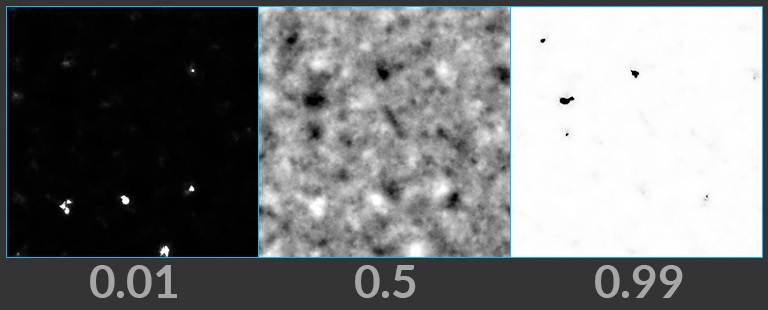
The amount to pull the medium grey values (around 0.5) towards zero (if Bias is less than 1) or one (if Bias is greater than 1). A bias value of 0.5 doesn’t affect the values.
Gain
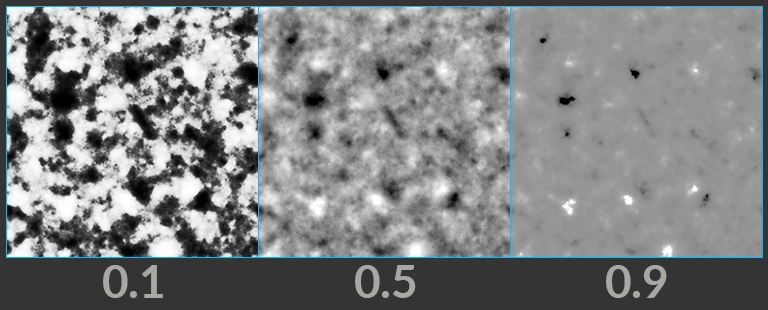
The amount to pull the medium grey values (around 0.5) together, while values around 0 and 1 are pulled apart. A gain value of 0.5 doesn’t affect the noise values.
Gamma
The overall gamma of the generated noise. Values greater than 1 increase the range of values in originally bright areas, which darkens the noise. Values less than 1 stretch out the range of values for originally dark areas, which increases the overall brightness of the noise.
Contrast
The amount to expand or shrink the overall range of tonal values. Each noise value is pushed towards (if Contrast is less than 1) or away from (if Contrast is greater than 1) medium grey values (around 0.5).
Note
This is not the same as Noise Contrast, which appears in some noise nodes and applies contrast during the noise function.
Clamp Minimum
Clamps values below the specified threshold.
Clamp Maximum
Clamps values exceeding the specified threshold.
size_ref
A representative layer that determines the size of the output image and controls the metadata.
grunge
The generated bark strips pattern.
| See also |

Transforms a layer to align with another layer.

Shifts a layer to align pixelwise with another layer.

Creates a detached attribute.

Extracts a detached attribute from a geometry.

Inserts a detached attribute into a geometry.

Attribute Sample with Adjacency
Creates a texture map of an attribute sampled from geometry.

Extracts a detached attribute from a layer.

Generates an image with a 3D illusion.

Generates textures by baking between a low-resolution and high-resolution mesh at interactive speeds.

Sets up rays for baking, with a visualization state.

Curves images using handles or a captured region.

Blends two layers, VDBs, or attributes together.

Start of a block, containing its inputs.

End of a block, declaring its outputs.

Compiles a block and produces its geometry representation.

Applies a blur to a layer.

Creates a Bokeh effect by expanding each pixel by an aperture shape.

Finds the bounding rectangle of a mask.

Brightens a layer, VDB, or attribute.

Generates bubble noise.

Removes empty wires from a cable.

Combines two cables into one cable.

Combines input layers into a cable.

Renames a cable’s wires based on filters.

Sorts a cable’s wires by name.

Splits a cable based on filtering parameters.

Selects an input cable.

Extracts individual wires from a cable.

Caches the input layers for faster playback.

Creates a camera.

Blends two cameras.

Creates a layer in a camera’s space.

Adjusts the camera properties of a layer.

Generates cellular patterns.

Generates cellular noise.
Generates cellular noise from 3D locations.

Extracts a channel from a layer, VDB, or attribute.

Combines multiple Mono layers, VDBs, or attributes into one multichannel output.

Divides the input’s channels into Mono layers, VDBs, or attributes.

Swaps channels within a multichannel layer, VDB, or attribute.

Creates an alternating checker pattern.

Generates interference patterns that represent various vibration modes.

Keys an input based on hue, saturation, and luminance ranges.

Adds chromatic aberration to your image.

Clamps an input layer, VDB, or attribute.

Generates a billowy cloud noise.

Adjusts colors in the image.

Blends two normal maps together.

Creates a mask by comparing two layers, VDBs, or attributes.

Compares two pixel values on a layer, VDB, or attribute and outputs either a true or false input for that pixel.

Creates stamp/sprite attributes on points with randomization controls and inputs.

Initializes pixels to constant values.

Arranges input layers into a contact sheet.

Applies contrast to a layer, VDB, or attribute.

Converts depth layers between height, depth, and distance.
Converts normal layers between signed and offset.

Convolves a layer by a 3×3 kernel.

Convolves an image with an arbitrary kernel image using an FFT.

Copies stamps and applies transformations to the copies.

Detects corners in an input layer.

Pins a layer’s corners in a reference layer.

Crops a layer to a new size.

Performs a cross product of two RGB layers, VDBs, or attributes.

Builds a matte from cryptomatte layers.
Decodes a cyrptomatte into coverage and ID.
Encodes a coverage and object hash into a cryptomatte layer.

Generates a sharp and angular Worley noise type.
Generates a sharp and angular Worley noise type from 3D locations.

Computes the curl of a vector field.
Generates curl noise.
Generates 3D curl noise.

Computes the curvature of a layer.

Lets you interactively draw Bézier curves using tools similar to 2D illustration programs, as well as polylines and NURBS.

Lets you interactively draw and animate Bézier curves using tools similar to 2D illustration programs, as well as polylines and NURBS.

Defocuses an input layer.

Denoises an input layer.
Removes white noise from an image.
Computes the derivative of the source layer along its width (x-axis) and height (y-axis).

Removes color spill from an input layer.

Dilates or erodes a layer.

Distorts an input layer.

Distorts a layer over texture seams using adjacency.
Performs dot product between two layers.

Composites a copy of a layer under the original to create a shadow.

Detects edges in the input image.
Detects varying-width silhouette lines.
Detects varying-width self-occluding silhouettes.
Detects varying-width crease-lines.
Computes distances by solving the Eikonal equation.

Equalizes colors by stretching or shifting their range.

Generates a message, warning, or error.

Fills empty areas of an image using colors at the edges of non-empty areas.

Fills areas of a texture outside the UV islands with information from their island neighbors.

Computes the Fourier transform of an image.

Smooths out sharp changes in contrast.

Brings a COP node’s outputs into the current network.

Loads an image or video from disk.

Fills a layer with a constant value.

Flood fills the connected regions of a layer.

Boosts or suppresses spatial frequencies in an image.

Flips a layer horizontally, vertically, or diagonally.

Start of a Flow simulation block.

End of a Flow simulation block.

Flow Project Non-Divergent Multigrid
Removes divergent components from a 2-dimensional vector field.

Rasterizes text onto a layer from Type 1, TrueType, and OpenType fonts.

Generates fractal noise.
Generates fractal noise from 3D locations.

Generates a fractal of the source input that you can randomize.

Applies a mathematical function to a layer.

Applies gamma correction to a layer, VDB, or attribute.

Samples layers with a geometry’s attribute to create attributes from those layers.

Rasterizes geometry to generate an adjacency cable.

Converts a volume, VDB, or camera primitive into a layer or VDB.

Adds glow to an image based on its luminance.
Generates a pattern resembling an aurora display.
Generates a pattern resembling bark strips.
Generates a pattern resembling the bark of a birch tree.
Generates a pattern resembling drips.
Generates a pattern resembling galvanized steel.
Generates a higher-level noise pattern by layering simple noises.
Generates a pattern resembling leaking streaks.
Generates a pattern resembling sponge-like moisture.
Generates a pattern resembling mold spots.
Generates a pattern resembling the bark of a pine tree.
Generates a pattern resembling rust on a surface.
Generates a pattern resembling a rusty surface.
Generates a pattern resembling sheets.
Generates a pattern resembling circular wipe trails.

Converts between RGB and HSV color spaces, or modifies HSV.

Distorts the input layer to simulate heat around fire and other mirage effects.
Distorts the input layer using another layer to simulate heat around fire and other mirage effects.

Imagines a sphere for each pixel and determines how occluded that sphere is based on its surroundings.

Creates caustic patterns on the ground from a refractive height layer.

Converts a height layer to a normal layer.

Creates shadows using a virtual light source.

Clamps height values to a minimum and/or maximum value.

Simulates hydraulic and thermal erosion at a specific scale to create more realistic terrain.

Creates a mask based on different features of the heightfield.

Projects 3D geometry onto a heightfield.

Simulates loose material sliding down inclines and piling at the bottom.

Adds sedimentary layering patterns to a HeightField.

Creates stepped plains from the slopes of a HeightField.

Transforms a height layer in 2D.

Transforms a height layer in 3D.

Visualizes layers as a colored heightfield by converting them into geometry

Converts a heightfield into a grayscale mono layer.

Randomly tiles texture.

Builds a histogram from a layer.

Generates hyperbolic polygon tiles for texture patterns.
Creates a mask from an ID layer based on filtering parameters.

Converts an ID layer, VDB, or attribute into a float.

Converts an ID layer, VDB, or attribute into an RGB layer, VDB, or attribute.
Computes a signed distance field from changes in ID values.

Detects and then fixes or highlights illegal pixels in images.

Fetches the input to a subnetwork.

Integrates a VDB along camera rays.

Inverts a layer, VDB, or attribute.

Runs a block using inputs plugged into this node.

Runs a program saved into geometry using inputs plugged into this node.

Computes the Julia set to create a fractal.

Generates a grid of knitted fabric stitches.

Applies the Kuwahara filter, which creates painterly effects.

Generates procedural UV grid textures.
Computes the Laplacian of a layer.

Applies grid-based deformation to a layer.

Generates a layer.

Combines all inputs.

Edits basic layer metadata.

Transfers layer properties from one layer, VDB, or attribute to another.

Adds or edits user-defined properties on a layer.

Removes user-defined properties from a layer.

Fills a layer from a detached attribute.

Render Curves into a Layer.
Sets a layer’s values from a VDB.

Converts a layer or VDB into geometry.

Creates points based on a layer.
Creates a point for each leaf of a VDB that would be in an envelope.

Adds radial and tangential distortion to a layer based on OpenCV coefficients.

Lights a layer given a light direction and normals.

Captures images from a live video source.

Applies logic operations to ID layers.

Apply a model trained using the ML Train Computer Vision TOP.

Combines several mask layers from an input cable into a single mask.

Creates a mask from 2D curves.
Transforms a layer to match a reference camera.

Reframes pixels of a layer to match a particular UDIM tile.

Applies a median filter to an image.

Mirrors an image based on an arbitrary number of planes.

Converts a layer, VDB, or attribute into a mono, VDB, or attribute.

Converts a mono layer into a heightfield.

Converts a mono layer, VDB, or attribute into an integer.

Converts a mono layer, VDB, or attribute into an RGB layer, VDB, or attribute.

Converts a mono layer into an RGBA layer.

Computes a signed distance field from an iso-level of a mono layer.

Runs a neural cellular automata model to evolve cell states.

Neural Cellular Automata Decode
Decodes a cell state from the Neural Cellular Automata Core into a visible pattern.

Neural Layer to Depth (MoGe-2)
Estimates metric-scale depth, normal, and position maps from an input image.

Creates a mask based on coordinates set through prompts.

Reconstructs a height layer from a normal layer.

Passes inputs to the outputs.

Converts color spaces using OCIO transforms.

Applies inference from an ONNX Machine Learning model.

Converts the layers of an ocean spectrum into an animated ocean surface.
Generates layers containing information for simulating ocean waves.

Executes an OpenCL kernel on layers, attributes, volumes, and VDBs.

Collects the outputs of a subnetwork.

Paint on a COP layer or UV-mapped geometry.

Generates phasor noise, which resembles a wave pattern.

Increases the size of pixels to pixelate an input layer.

Inflates a 2D signed distance field into a height layer.

Deletes points from a point cloud geometry.

Adds points to a point cloud geometry.

Merges point cloud geometries.

Creates points from blobs in an input layer.

Converts polar coordinate pixels to Cartesian pixels.

Generates a position map.

Samples an input texture by position.
Computes the prefix sum of a layer.

Premultiplies or un-premultiplies an RGBA layer.

Applies the preview material to geometry.

Projects a layer onto a target layer.
Changes the activation of VDBs in a Pyro simulation.
Advects VDBs by Velocity.
Advects a VDB by a flow map.

Applies a force around an axis to a velocity VDB.

Start of a Pyro simulation block.

End of a Pyro simulation block.
Constructs a flow map from a velocity VDB.

Applies a Buoyancy force.

Creates points representing implicit surfaces to add collision objects into a Pyro simulation.

Adds collision from pyro collision points representing implicit surfaces, into a VDB.

Configures a Pyro simulation.
Dissipates a VDB’s values over time.

Applies disturbance to a velocity VDB to break up still air.

Burns up the flame field.

Builds a light field of ambient illumination of a VDB.

Builds a light field of internal glow of a VDB.

Builds a light field of points lighting a VDB.
Builds an in-place MipMap of a VDB.
Pyro Project Non-Divergent Electro Static
Removes divergence from a velocity VDB.

Creates points representing implicit surfaces to source into a Pyro simulation.

Sources from a layer’s envelope into a VDB.

Sources points into a VDB.

Sources from pyro source points representing implicit surfaces, into a VDB.

Sources from a VDB into another VDB.

Apply turbulence to a velocity VDB.

Applies a uniform force.

Scales fluid velocity based on the fluid’s current speed.

Applies a vortex confinement force to a velocity field.

Runs a snippet of Python on layers.

Quantizes input data into discrete steps.

Converts RGB layers or attributes to RGBA.

Splits an RGB layer or attribute into UV and mono layers or attributes.

Converts RGBA layers or attributes to RGB.

Splits an RGBA layer or attribute into two UV layers or attributes.

Writes the output of a COP network to disk.

Generates linear and radial ramps.

Creates a mono layer, VDB, or attribute with random values.

Creates an RGB layer, VDB, or attribute with random colors.

Rasterizes curves onto a layer.
Rasterizes Gaussian Splats onto layers.
Rasterizes geometry onto a layer.

Rasterizes an implicit surface onto a layer.
Rasterizes a layer onto another layer’s camera.
Prepares geometry for the Rasterize Geometry COP.
Renders a volume viewed through a camera.

Performs ray tracing on an input mesh based on an origins and directions map.

Reaction-Diffusion Block Begin
Start of a Reaction-Diffusion simulation block.

Creates unique patterns by solving the reaction and diffusion of multiple chemicals as described by its inputs and parameters.
Refracts an image through a height layer.

Remaps a layer, VDB, or attribute.

Performs image scaling by changing the width, height, and pixel sizes.

Start of a Ripple simulation block.

End of a Ripple simulation block

Modifies the values for a Mono SDF layer.

Combines two Mono SDF layers.

Builds a 2D signed distance field of a selected shape.

Converts an SDF field to a mono image layer.

Converts an SDF field to an RGB color layer.

Imports SOP geometry into Copernicus.
Invokes a compiled SOP block on the inputs.

Invokes a geometry SOP graph on the inputs.

Scatters input stamps across the image using randomization controls.

Scatters input stamps along an input curve using randomization controls.

Segment a layer into connected components.

Segment a mono layer into bands of similar value.

Sequences parts of one or more inputs temporally.

Blends multiple layers together.

Sharpens an input layer to increase the definition of its edges.

Import live layers from the Solaris Viewport.

Converts a height layer into a direction layer.

Smoothly fills a region of a layer.

Solves Poisson’s equation inside a 2D boundary.

Solves Poisson’s equation in a rectangular region using geometric multigrid.
Transforms positions and UV values between spaces.

Space Transform with Adjacency
Transforms a vector from world space into tangent space.

Samples a layer onto a sphere.

Stamps layers from point positions.

Streaks the layer multiple times in different directions to create a star effect.

Stashes the input of the node on command and uses it as the node’s output.

Outputs the average, minimum and maximum values of the input layer
Compute statistics for each ID island.

Streaks an image, adding a motion blur effect.

Used to organize a collection of COPs into one node.

Applies a halftone dithering pattern relative to UVs.

Twists an image layer into a spiral shape.

Selects an input layer.

Selects an input based on what is connected.
Selects an output layer by the type of the inputs.

Creates a capybara, which can be used as test geometry.

Creates Otto, a production quality test character.

Creates a pig head, which can be used as test geometry.

Creates a rubber toy, which can be used as test geometry.

Creates a shader ball, which can be used to test shaders.

Creates a squab, which can be used as test geometry.

Creates a soldier, which can be used as test geometry.

Generates rectangular tiles for texture patterns.

Blends intraframe values for layers and VDBs.

Repeats input frame range to form a looping animation.

Combines its input at multiple times into a cable.

Cooks its input at a different time.

Applies a filmic tone mapping curve to compress a high dynamic range input into a displayable range.

Transforms a layer in 2D.

Transforms a layer in 3D.

Generates a texture by projecting X, Y, and Z textures onto the position layer.
Seamless texturing and normal mapping of triplanar projections without visible repetitions.

Generates UVs in three orthogonal projections.

Applies a filter to create Turing patterns.
Selects between two inputs based on if you wire in another input.

Combines its input at multiple UDIMs into a cable.

Represents a USD material referenced from disk.

Computes the inverse of a UV distortion map.

Generates a UV Map.
Creates a UV Map for each connected ID island.

Samples an input layer using a UV layer or attribute.

Generates UV coordinates for 2D shapes.

Transforms the values of a UV layer in 2d space.

Converts Cartesian coordinate pixels to polar coordinate pixels.

Combines a UV and mono layer or two attributes to create an RGB layer or attribute.

Joins two UV layers or attributes into an RGBA layer or attribute.
Activates leaves on a VDB according to a point cloud.
Creates a point for each active leaf in a VDB.
Stores in each voxel that voxel’s position.
Rebuilds a VDB to match another VDB’s topology.

Creates multi-volume visualization.

Extracts a slice from a VDB as Geometry for visualization.
Builds a geometry visualizing the topology of a VDB.

Traces streamers through a velocity VDB.
Sets VDB values from the closest values in a layer.

Transforms values of an RGB layer, attribute, or Vector VDB in 3D space.

Transforms the values of a UV layer or attribute in 2D space.

Darkens the corners of an input layer.

Creates an RGBA Layer visualizing a 2d velocity field.

Generates a woven fabric pattern of interlacing fibers.

Performs a wipe transition between two images.

Generates Worley noise.
Generates Worley noise from 3D locations.

Runs a VEX snippet to modify layer values.

Composites two layers by depth.