| On this page |
matrix volumetransform(<geometry>geometry, int primnum, string src, string trg)
matrix volumetransform(<geometry>geometry, string volumename, string src, string trg)
For a given volume, this function returns the transformation matrix from src space to trg space. Both spaces must be one of "texture", "local", "voxel", "index", or "world".
This function is very similar to primintrinsic(geo, "transform", primnum), which returns a transform from a reference space to world space. However, volumetransform provides more precise control about the source and target spaces of the transform.
Spaces 
Here are visualizations of all the different spaces. For illustration purposes we show only 2D volume.
-
"texture"– Unit cube[0,1]³.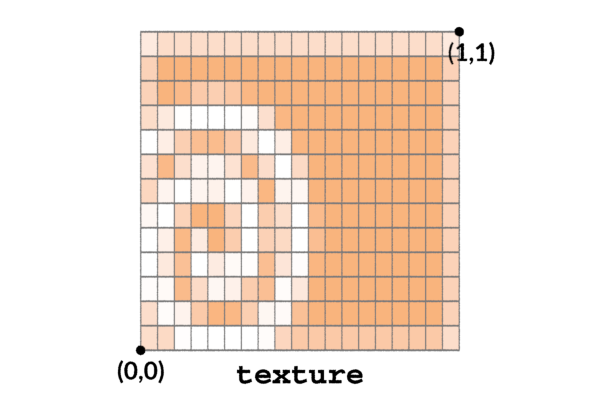
-
"local"– Reference cube[-1,1]³.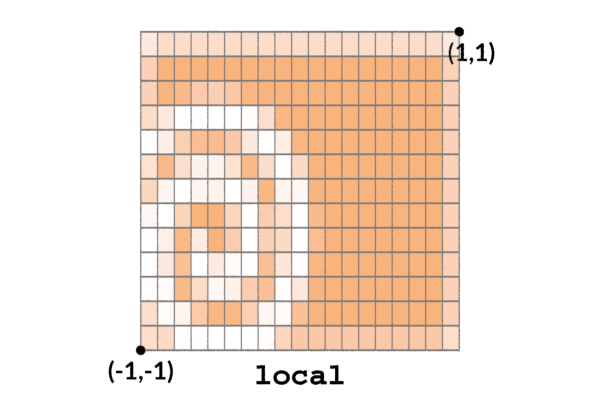
-
"voxel"– Voxel space[0,xres]×[0,yres]×[0,zres]with voxels centered at half-integer coordinates.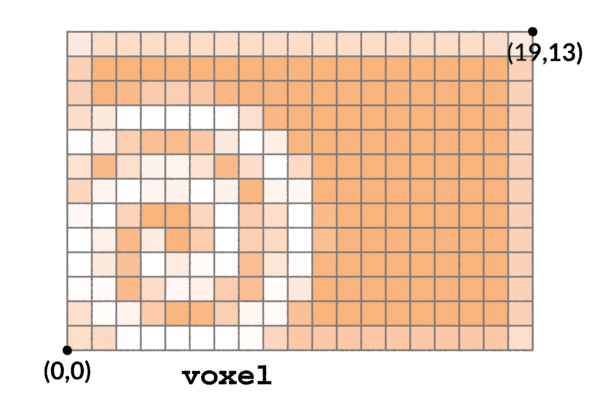
-
"index"– Index space[-0.5,xres-0.5]×[-0.5,yres-0.5]×[-0.5,zres-0.5]with voxels centered at integer coordinates.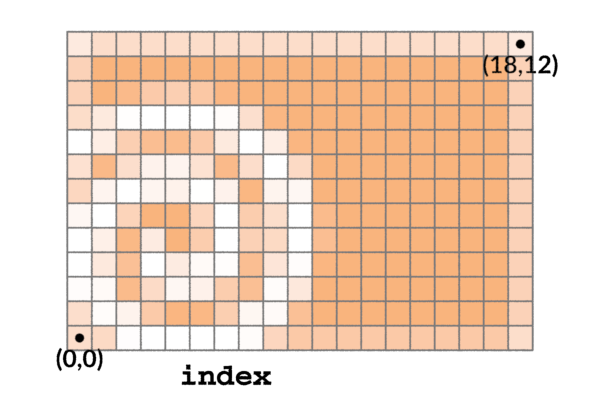
-
"world"– World space.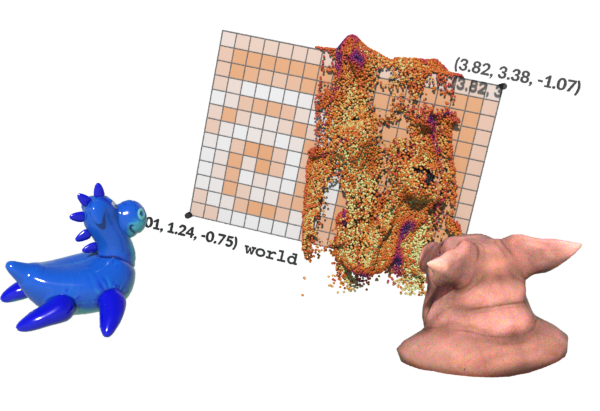
Arguments 
<geometry>
When running in the context of a node (such as a wrangle SOP), this argument can be an integer representing the input number (starting at 0) to read the geometry from.
Alternatively, the argument can be a string specifying a geometry file (for example, a .bgeo) to read from. When running inside Houdini, this can be an op:/path/to/sop reference.
primnum
The index of the volume primitive.
volumename
The name of the volume primitive.
src
Source coordinate space to transform from. Must be one of: "texture", "local", "voxel", "index", or "world".
trg
Target coordinate space to transform to. Must be one of: "texture", "local", "voxel", "index", or "world".
Returns
The transform matrix between src and trg spaces of a given volume.
Returns 0 if primnum or inputnum is out of range, the geometry is invalid, the given primitive is not a volume primitive, or the source or target space are invalid.
Relation to intrinsic transform 
The primitive intrinsic "transform" behaves differently for volumes and VDBs.
For volumes, the intrinsic returns "local" to "world" 3×3 matrix which is missing the translation by the volume position.
matrix3 A = primintrinsic(geo, "transform", vol);
matrix B = volumetransform(geo, vol, "local", "world");

matrix3(B) == A;
For VDBs, the intrinsic returns "index" to "world" 4×4 matrix.
matrix A = primintrinsic(geo, "transform", vdb);
matrix B = volumetransform(geo, vdb, "index", "world");

B == A;
Relation to volumeindextopos 
This function is tightly connected to VEX functions volumepostoindex and volumeindextopos. You can relate them to volumetransform, but you have to be careful as they always round the coordinates to the closest integer value in the index space.
vector voxel;
vector P;

matrix index_to_world = volumetransform(geo, vdb, "index", "world");
matrix world_to_index = volumetransform(geo, vdb, "world", "index");

volumeindextopos(geo, primnum, voxel) == index_to_world * rint(voxel);
volumepostoindex(geo, primnum, P)     == rint(world_to_index * P);
Examples 
vector P_world = {1.0, 2.0, 3.0};
vector v_world = {10.0, -2.0, 0.0};

matrix A = volumetransform(0, "density", "world", "index");

// Transform points
vector P_index = A * P_world;
// Transform vectors
vector v_index = matrix3(A) * v_world;
| volume |
|